
Driving Blind? Ontario Auto Insurance Changes
Driving Blind? The Major 2026 Ontario Auto Insurance Changes You Can’t Ignore
AUTO SERVICEFARMTRANSPORTATIONRESORT/HOTELS/CAMPSGENERAL ARTICLESMANUFACTURINGRETAILRESTAURANTS

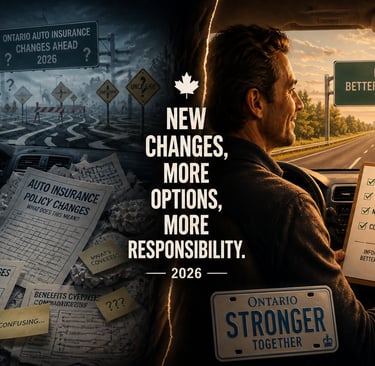
Driving Blind? The Major 2026 Ontario Auto Insurance Changes You Can’t Ignore
Ontario’s auto insurance system is going through its most significant change in decades. Starting July 1, 2026, the province is moving away from a standardized bundle of accident benefits toward a system where most benefits are optional and selected by the driver.
The government says this gives drivers more choice and could lower premiums. The reality is more complex: if you don’t actively review your coverage, you and your family could end up significantly underinsured.
Below is what’s changing, what stays mandatory, and what you should do before your next renewal.
The Big Shift: Mandatory vs. Optional Benefits
Historically, every Ontario auto policy included a comprehensive set of accident benefits by law. Starting July 1, 2026, that bundle is being broken apart.
What Stays Mandatory
The following benefits remain required on all Ontario auto insurance policies:
Medical benefits
Rehabilitation benefits
Attendant care benefits
These cover essential post-accident recovery support and cannot be removed. You can still purchase additional or increased coverage for medical, rehabilitation, attendant care, dependent care, and indexation benefits if you want more protection.
What Becomes Optional
All other accident benefits become optional. You must actively choose to keep them; otherwise, you won’t have them after an accident.
The newly optional benefits include:
Income replacement – Lost wages if an injury prevents you from working
Non-earner benefits – Financial support for students, unemployed, or others not in the workforce who can’t lead a normal life after an accident
Caregiver benefits – Costs for care you can no longer provide to a child, aged parent, or other household member
Lost educational expenses – Tuition, books, and other costs if an accident prevents you from attending school or a program
Expenses of visitors – Reasonable costs for visitors if you’re injured
Housekeeping and home maintenance – Costs for cleaning, yard work, and other tasks you can no longer do after an accident
Damage to personal items – Repair or replacement of clothing, prescription eyewear, hearing aids, and other personal items damaged in the crash
Death benefits – Compensation to certain family members if you die due to an auto accident
Funeral benefits – Help covering some funeral costs if you die due to an auto accident
If you opt out of these to lower your premium, you lose access to them entirely.
Who Is Covered Under the Optional Benefits?
Starting July 1, 2026, the optional benefits apply only to:
The named insured
The spouse of the named insured
Dependents of the named insured and their spouse
Drivers specifically listed on the policy
This means some people who may have been covered before—such as pedestrians, cyclists, and certain passengers—may no longer be eligible for these optional benefits.
The New First-Payer Rule for Medical and Rehab
Under the reform, auto insurance becomes the first payer for medical and rehabilitation expenses resulting from a crash, excluding medication. You will no longer be required to exhaust your workplace or private extended health care plans first.
This is designed to preserve your employee benefits for non-accident health events.
What This Means for Your Next Renewal
If You’re an Existing Customer
Your policy will renew automatically with your current coverage and limits, unless you agree in writing to decline benefits or make changes.
Most insurers will not automatically strip your coverage to the minimum. However, you should still review your policy before renewal to confirm what you have and whether it still fits your needs.
If You’re a New Customer or Buying After July 1, 2026
For policies purchased or renewed on or after July 1, 2026, you can choose which optional accident benefits you want to purchase.
Quotes will not automatically include the full historical bundle. You may need to ask specifically which benefits are included and which are optional.
Action Plan: Don’t Autopilot Your Next Renewal
This is not a wait-until-renewal issue if you want to be fully informed. Do a quick risk audit before accepting any quote:
Check your workplace disability coverage
Do you have solid short- and long-term disability through work? If not, dropping income replacement is very risky.Evaluate your household situation
If you are self-employed, a gig worker, a stay-at-home parent, a student, or a caregiver for a child or aging parent, then non-earner and caregiver benefits are critical lifelines.Review your private benefits plan
Check your extended health, dental, and life insurance to avoid unnecessary duplication, but also to spot gaps.Talk to your broker early
Stripping your policy down to the mandatory minimums might save a small amount on premiums, but a single serious collision could result in massive, life-altering out-of-pocket costs for lost income, caregiving, housekeeping, and personal items.
Bottom Line
The 2026 Ontario auto insurance reform gives drivers more control, but it also puts more responsibility on them to understand what they’re buying.
For most families, self-employed workers, and small business owners, keeping optional benefits like income replacement, non-earner, and caregiver coverage is far safer than chasing a slightly lower premium.
Talk to your insurance broker before your next renewal to make sure your coverage matches your real-life risks.
Disclaimer: This article is for general information purposes only and does not constitute legal, financial, or insurance advice. Insurance rules and coverage details can change, and individual circumstances vary significantly. For specific guidance about your policy, coverage options, or how these changes affect your situation, please contact a licensed insurance broker, agent, or insurer directly. You may also want to review the official Statutory Accident Benefits Schedule (SABS) or consult with a legal professional for personalized advice.