
2026: A Big Year for Driving Rule Changes
Ontario’s driving rules just got a major upgrade, and for fleets, garages, and tow operators, these changes are more than “driver news.” They quietly reshape hiring, risk management, and how insurers view your operation.description.
TRANSPORTATIONGENERAL ARTICLES
2026: A Big Year for Driving Rule Changes
Ontario’s driving rules just got a major upgrade, and for fleets, garages, and tow operators, these changes are more than “driver news.” They quietly reshape hiring, risk management, and how insurers view your operation.
As of July 1, 2026, Ontario introduced ten new rule groupings affecting impaired drivers, newcomers, commercial operators, tow companies, and highway speeds. These changes arrive alongside recent auto insurance reforms, making 2026 a year where business owners can’t afford to assume “everything is the same as last renewal.”
10 new rule groupings in plain language
Here’s what changed, in everyday terms:
Mandatory ignition interlock for many new impaired driving convictions, tying drivers to breathalyzer-equipped vehicles for a set period.
A six‑month “zero‑tolerance” condition after the interlock comes off—any alcohol or drug presence can trigger serious consequences.
New administrative licence suspensions for zero‑tolerance violations, allowing roadside enforcement and fast suspensions without waiting for lengthy court processes.
Tighter foreign licence testing rules for newcomers from non‑reciprocal countries: capped credit for foreign experience, mandatory G1/G2/G steps, and a 12‑month wait between G2 and G.
Cancellation of planned annual fee increases for road tests and driver’s licences—a freeze that keeps licensing fees from rising year after year.
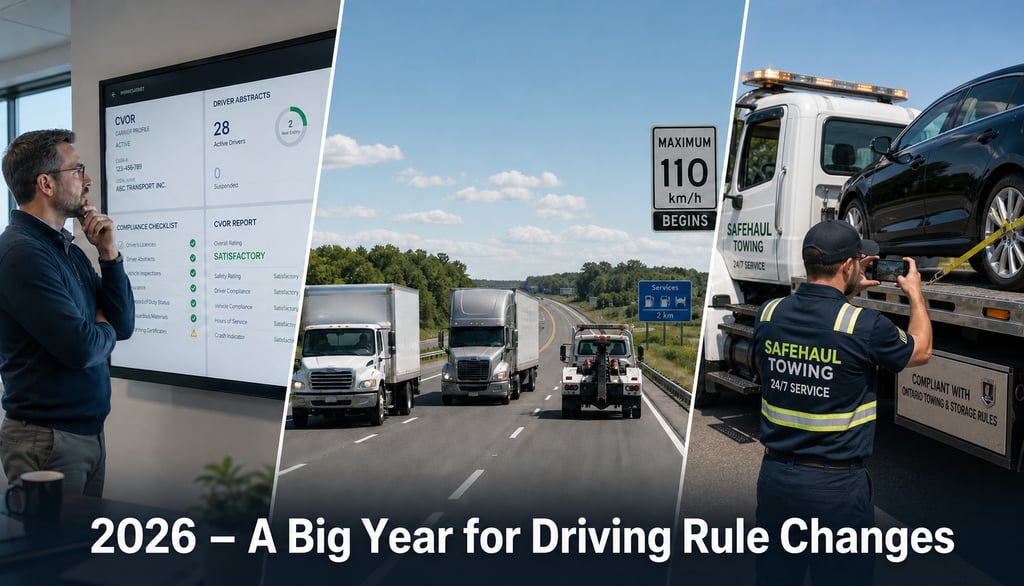
Increased oversight of commercial vehicle operators, including stronger powers for the Registrar to monitor and intervene in CVORs.
Administrative penalties for commercial operators and driver training schools, with streamlined processes and online payment options.
Tougher rules for tow operators and vehicle storage, focusing on documentation, transparency, and consumer protection (including fee controls).
Permanent speed limit increases to 110 km/h on selected sections of Highway 400's.
A new experience requirement for Class A applicants: a minimum period with a full Class G licence (or equivalent) before attempting the Class A road test, coming into effect in 2027.
For the average driver, these are compliance issues. For a business that depends on vehicles, they’re risk-management and insurance issues.
Impaired driving rules: more follow‑through, more employer impact
The impaired driving changes create a multi-step framework that doesn’t end with a conviction.
Ignition interlock means a driver’s vehicle literally won’t move unless they pass a breath test, which makes “one bad decision” harder—but not impossible.
The six‑month zero‑tolerance period and new administrative suspensions mean the consequences of any slip are immediate and significant, with licence status changing quickly.
For fleets and garage operations, this raises the stakes around driver policies, record checks, and how you respond to impaired or high‑risk behaviour. A single incident can now cascade into licence loss and operational disruption far faster than many owners realize.
Newcomer licensing: fewer shortcuts into full G
Ontario is also tightening how newcomers from non‑reciprocal countries move through the licensing system.
Foreign driving experience is now capped at 12 months of credit, even if someone has many years abroad.
These drivers must go through G1, pass a G2 road test, then wait around 12 months before attempting a full G road test.
For employers, this means fewer new arrivals jumping directly into full G licences and, by extension, into commercial or fleet roles. It pushes hiring more toward drivers whose experience is documented within Ontario’s graduated licensing system, which may reduce some unknowns but tighten the labour pool.
Commercial vehicle oversight and penalties: CVOR under the microscope
On the commercial side, Ontario is giving itself more tools to watch and correct operator behaviour.
The Registrar can now impose conditions on a CVOR certificate at any point, not just when it’s issued or renewed.
Administrative penalties for commercial operators and driver training schools are more clearly defined and easier to apply and collect.
For fleet owners, this means poor safety performance or compliance issues can turn into CVOR conditions and penalties more quickly. Insurers watch CVOR profiles closely; a deteriorating record or new conditions can affect rates, deductibles, and even market appetite for your risk.
Tow operators and storage: documentation and transparency
Towing and vehicle storage—areas that already attract scrutiny—are getting tougher rules as well.
Tow operators face stricter requirements on how they document vehicles (photos, conditions, positions), identify themselves and their credentials.
Fees for towing and storage are being held in check to protect consumers, with some increases delayed into 2027.
For garages that also tow, or for businesses relying on third‑party towers, this is a push toward better documentation and clearer accountability when a vehicle is moved or stored after a loss. Good documentation can make claim investigations smoother and reduce disputes, which matters both for insurers and for your relationship with customers.
Speed limit increases: more legal speed, unchanged physics
The permanent 110 km/h limits on portions of 400's Highways, bringing legal speeds up, but they don’t change physics or enforcement thresholds.
Vehicles can now legally travel faster on some corridors, which may help traffic flow and scheduling.
However, stunt driving thresholds and serious penalties still apply, and higher speeds generally mean higher severity when losses occur.
For fleets and tow operations, this is a reminder that telematics, speed policies, and route management are risk tools, not just productivity tools.
Class G experience requirement for Class A: raising the bar
Looking ahead to 2027, Ontario will require Class A applicants to have a minimum amount of full G experience before attempting a Class A road test.
Candidates will need to hold a full G licence (or equivalent) for a set period, six months or more, before they can test for Class A.
Some equivalent Canadian or military experience can qualify, but novice status time doesn’t count.
For trucking and heavy commercial operations, this codifies what many safety‑focused employers already prefer: drivers should demonstrate competence in lighter vehicles before stepping into heavy equipment. It shapes the pipeline of future Class A drivers and may improve baseline experience over time.
What this means for your insurance and operations
Taken together, these changes push Ontario toward:
More structured, documented driver experience for both newcomers and aspiring commercial drivers.
Faster, more targeted enforcement against impaired and unsafe driving, with tools that affect licence status and CVOR profiles quickly.
Greater transparency and accountability in towing and storage, which should support cleaner claims and fewer disputes.
For business owners, the opportunity is to align hiring practices, driver policies, and documentation with this new landscape, and then make sure your commercial auto and fleet insurance reflects that stronger risk profile. That’s where a broker who lives in this space can help, give us a call and we can assist your journey through the new rules.
Disclaimer: This article is for general information purposes only and does not constitute legal, financial, or insurance advice. Insurance rules and coverage details can change, and individual circumstances vary significantly. For specific guidance about your policy, coverage options, or how these changes affect your situation, please contact a licensed insurance broker, agent, or insurer directly. You may also want to review the policy wording or consult with a legal professional for personalized advice.